
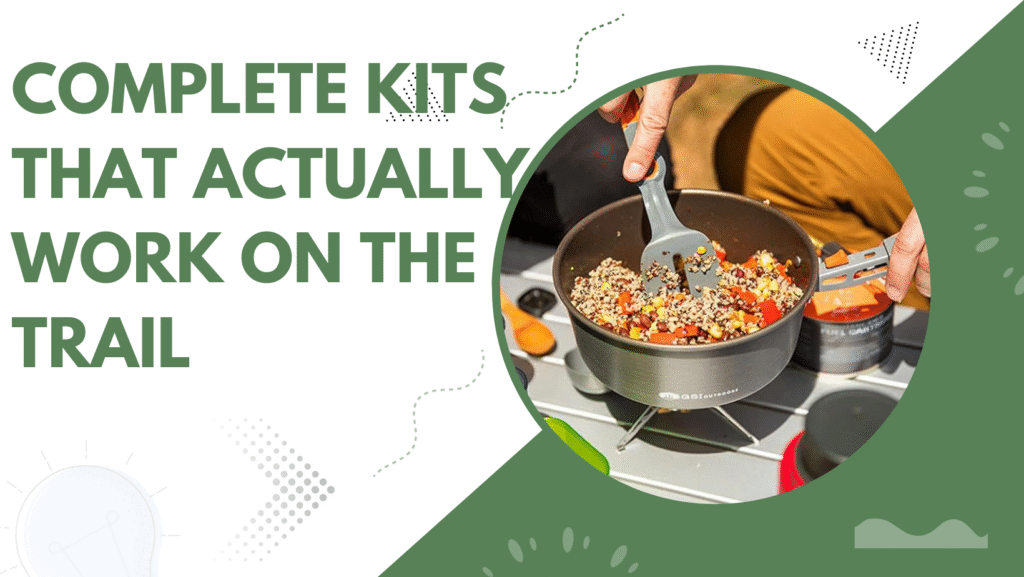
I’ll never forget my first backpacking trip where I tried to cook with a mismatched collection of pots and pans from my kitchen. The handles didn’t fold, nothing nested together, and I ended up carrying 8 pounds of cookware for what should have been a 2-pound kit. That’s when I learned that specialized camping cookware isn’t just a luxury—it’s a necessity if you want to eat well without destroying your back.
Over the past four years, I’ve cooked hundreds of meals on various camping cookware sets, from budget options that barely survived a weekend to premium kits that have become permanent fixtures in my gear closet. I’ve boiled water at 10,000 feet, simmered stews on windy beaches, and learned exactly what separates exceptional camping cookware from expensive junk.
This guide breaks down four outstanding cookware sets that cover every camping style and budget. Whether you’re feeding a family at the campground or counting ounces for a solo backpacking trip, one of these kits will transform your outdoor cooking experience.
What Makes Good Camping Cookware Different
Before we get into specific recommendations, let’s talk about why you can’t just grab pots from your kitchen and call it camping gear.
Weight and Packability Matter
Every ounce counts when you’re carrying your kitchen on your back. Good camping cookware uses lightweight materials like aluminum or titanium and nests together efficiently. A well-designed set that feeds four people should pack down to roughly the size of a large coffee can.
Even for car camping, compact cookware means more room for other gear, easier packing, and simpler organization.
Durability in Harsh Conditions
Camping cookware takes abuse that home pots never see—direct flame from camp stoves, thermal shock from cold mountain streams, getting dropped on rocks, and constant packing and unpacking. Thin spots, weak handles, and poor construction fail quickly in the outdoors.
The cookware I’m recommending has proven itself through dozens of trips without warping, handle failure, or coating degradation.
Heat Distribution and Control
Cooking on a camp stove isn’t like cooking on your home range. You’re dealing with concentrated heat, wind interference, and limited temperature control. Good camping cookware features thick enough bases to distribute heat evenly and prevent hot spots that burn food.
Easy Cleaning Without a Sink
When your “sink” is a bucket of lake water or a camp spigot 200 yards away, easy cleaning becomes critical. Non-stick coatings, smooth surfaces, and thoughtful design all contribute to making cleanup less miserable after a long day on the trail.
Now let’s look at the cookware sets that get these details right.
Our Top 4 Camping Cookware Recommendations
1. MSR Alpine 2 Pot Set

- Stainless steel construction is incredibly strong and offers the ultimate in durability
- Efficient nesting design is compact and saves valuable space in your pack
- Lid fits both pots and can be used as a plate
Best Overall for Backpacking and Lightweight Camping
If you’re serious about outdoor cooking and want cookware that will last a decade of adventures, the MSR Alpine 2 Pot Set is the gold standard. I’ve been using this set for three years, and it’s become so reliable that I don’t even think about it anymore—it just works, trip after trip.
What’s Included:
- 1.5-liter pot with lid
- 2-liter pot with lid (doubles as frying pan)
- Folding pot gripper handle
- Welded stuff sack
This minimalist setup feeds 2-3 people comfortably or works perfectly for solo/duo backpacking.
Material and Construction:
The pots are made from hard-anodized aluminum, which is the sweet spot for camping cookware. It’s lighter than stainless steel, more durable than standard aluminum, and heats evenly without the premium cost of titanium.
The hard-anodized coating is incredibly tough. I’ve accidentally scraped these pots with metal utensils, dropped them on rocks, and subjected them to countless heating cycles, and they show minimal wear. The coating also creates a naturally non-stick surface that improves over time—not Teflon-level, but good enough that eggs slide around with minimal oil.
Heat Performance:
The base thickness is perfect—thick enough to prevent hot spots but thin enough to boil water quickly. On my MSR PocketRocket stove, I can boil a liter of water in about 4 minutes at sea level. The pots also handle simmering well, which many lightweight options struggle with.
I’ve made everything from simple ramen to elaborate one-pot pasta dishes, and the heat distribution has been consistently excellent. The tapered shape helps focus heat efficiently, reducing fuel consumption—a real benefit on multi-day trips.
Design Details That Matter:
The lids fit securely with a slight lip that prevents spillage when pouring. They also have strainer holes, which seems like a small thing until you’re draining pasta without dumping dinner into the dirt. The handles on the lids stay cool enough to touch briefly, though I still use the pot gripper for safety.
The pot gripper handle is ingenious—it locks onto the rolled rims securely and folds flat for packing. After initially being skeptical (I prefer bail handles), I’ve come to appreciate how stable it is. The pots nest inside each other perfectly with room for a small fuel canister and stove inside—brilliant space efficiency.
Real-World Usage:
I’ve used this set on 40+ nights of camping, from weekend trips to week-long backpacking adventures. It’s cooked meals at sea level campgrounds and at 11,000 feet in the Rockies. The versatility is remarkable—I’ve boiled water for coffee, simmered chili, sautéed vegetables, and even baked campfire brownies using the lid as a makeshift oven.
For two people, this set is perfect. For three, it works but feels a bit snug. For solo camping, it’s more cookware than you need but still reasonable if you want options.
Cleaning and Maintenance:
The hard-anodized surface releases food reasonably well and cleans easily with just hot water and a camp sponge. After three years of use, there’s no flaking, peeling, or degradation of the coating. I occasionally scrub with a gentle abrasive (like a ScotchBrite pad) to remove stubborn residue, and the surface handles it without issue.
Minor Considerations:
At 16 ounces for the set, it’s not the lightest option available. Ultralight backpackers obsessing over every gram might prefer titanium. The set also doesn’t include plates or cups, so you’ll need to add those separately.
The price ($75-90) is higher than budget options, but the quality justifies it. This is one of those “buy once, cry once” items that pays for itself over years of reliable use.
Who Should Buy This:
- Backpackers who want quality that lasts
- Couples or small groups camping together
- Anyone doing multi-day trips where reliability matters
- Campers who appreciate thoughtful design
- People who want one versatile set for various camping styles
Product to Search: MSR Alpine 2 Pot Set
Price Range: $70-90
2. Coleman Aluminum Cookset (10-Piece)
Best Value for Family Car Camping
When you need to feed a family without spending a fortune, the Coleman 10-piece cookset delivers remarkable value. This is the set I lend to friends trying camping for the first time because it’s affordable, complete, and nearly indestructible.
What’s Included:
- 7.5-inch frying pan
- 6-quart pot with lid
- 2-quart pot with lid
- Four enamel plates (9-inch)
- Four enamel cups
- Mesh storage bag
This is a complete kitchen that feeds four people comfortably, and it costs less than a nice restaurant meal for four.
The Reality of Budget Cookware:
Let’s be honest about what you’re getting at this price point ($45-60). This isn’t precision-engineered equipment—it’s functional camping cookware that gets the job done without pretense. The aluminum is thinner than premium options, the handles are basic, and the non-stick coating won’t last forever.
But here’s the thing: for car camping where weight doesn’t matter and you’re not subjecting gear to extreme conditions, this set is absolutely adequate. I’ve used it on at least 20 family camping trips over two years, and it’s still going strong.
Cooking Performance:
The pots heat reasonably well, though you’ll notice some hot spots if you’re paying attention. For typical campground cooking—boiling water for pasta, heating canned soup, warming beans—they work fine. The non-stick coating is helpful but requires some care (avoid metal utensils, don’t overheat).
The 6-quart pot is genuinely large—great for family meals, boiling corn, or making a big batch of chili. The 2-quart pot handles smaller tasks like heating soup or making oatmeal. The frying pan is adequate for eggs and pancakes, though the non-stick performance is only mediocre.
The Plates and Cups:
The included enamelware dishes are surprisingly nice. They’re durable metal with enamel coating—the classic camping aesthetic. They don’t break like plastic, don’t conduct heat like bare metal, and feel more “real” than paper plates.
The cups hold about 12 ounces and work for coffee, hot chocolate, or cold beverages. They stack nicely for storage. After two years, the enamel shows some minor chipping on the rims, but nothing that affects function.
What Makes This Set Work:
The completeness is the real value proposition. You get everything you need to cook and serve meals for four people. No trying to figure out what you’re missing, no buying add-ons—just grab the bag and go camping.
The mesh storage bag is basic but functional. Everything fits inside reasonably well, though it’s a bit of Tetris to get it all nested. The bag has held up fine to being tossed in the car trunk repeatedly.
Honest Limitations:
This cookware is heavy—about 6.5 pounds for the set. That’s completely fine for car camping but absolutely not for backpacking. The aluminum is thin enough that you need to watch temperatures to avoid warping. The non-stick coating will eventually wear off with heavy use (I’m seeing some degradation after 20+ uses).
The handles on the pots get hot—you’ll need a pot holder or towel. The frying pan handle isn’t heat-resistant either. Also, while the pots nest inside each other, it’s not as elegant as more expensive sets.
Perfect Use Cases:
This set excels for:
- Family campground camping
- Large groups at established campsites
- Teaching kids to cook outdoors
- Infrequent campers (a few times per year)
- Anyone who needs a complete starter kit
- Car camping where weight is irrelevant
Not Ideal For:
- Backpacking (way too heavy)
- Serious outdoor cooks who want precision
- People who camp weekly (you’ll outgrow it)
- Winter camping (aluminum conducts cold)
The Bottom Line:
For $50, you get everything you need to cook and eat at the campground. Will this set last 10 years of heavy use? Probably not. Will it serve you well for family camping trips over several years? Absolutely. Sometimes good enough is exactly what you need.
Product to Search: Coleman Aluminum Cookset 10 Piece
Price Range: $45-65
3. Stanley Adventure Base Camp Cook Set

- DELICIOUSNESS ON THE GO: Prepare enticing meals wherever adventure leads you with Stanley’s 6PC Even-Heat Essential Cook…
- EVEN HEATING, EVERY TIME: Whether you’re cooking over an alcohol stove, campfire, or twig burner, your food comes out ev…
- LEGENDARY STANLEY QUALITY: Go out camping, hiking, backpacking, or tailgating, and watch these outdoor cooking accessori…
Best for Rugged Durability and Large Groups
Stanley built their reputation on indestructible thermoses, and they’ve applied that same “build it once, build it right” philosophy to this cookware set. If you need gear that can handle rough use, feed larger groups, and literally last a lifetime, the Stanley Base Camp Cook Set is worth the investment.
What’s Included:
- 10-inch frying pan with lid
- 5.5-quart pot with lid
- Four 16-ounce stainless steel bowls
- Vented carry case
This set is designed to feed 4-6 people and feels more like restaurant equipment than camping gear.
Stainless Steel Construction:
Unlike most camping cookware that uses aluminum, Stanley went with 18/8 stainless steel. This makes the set significantly heavier (about 8 pounds), but the tradeoff is durability that borders on absurd.
I’ve been using this set for two years in some genuinely rough conditions—beach camping with sand and salt, desert camping with dust and grit, and general family chaos with kids. The stainless steel shows absolutely no wear. No scratches that matter, no dents, no coating to degrade. It looks nearly identical to when I bought it.
The stainless steel is also completely non-reactive, so you can cook acidic foods like tomato sauce without any metallic taste. You can use metal utensils without worry. You can scrub it with steel wool if you burn something. It simply doesn’t care what you throw at it.
Cooking Performance:
Stainless steel doesn’t conduct heat as efficiently as aluminum, which means two things: it takes slightly longer to heat up, but once hot, it holds heat beautifully. This makes it excellent for dishes that benefit from consistent heat—like simmering stews or maintaining temperature while serving.
The thick base (3mm) provides excellent heat distribution. I’ve had minimal issues with hot spots, even when cooking on uneven camp stove flames. The 5.5-quart pot is large enough to make meals for my family of five with leftovers.
The 10-inch frying pan is a workhorse. I’ve made pancakes for six people, sautéed vegetables for fajitas, and fried fish. The size is genuinely useful—not like those tiny 7-inch pans that force you to cook in batches.
The Bowls Are Exceptional:
The four included stainless steel bowls have become my favorite camping dishes. They’re substantial (not flimsy), the right size for hearty portions, and virtually indestructible. They nest inside each other and inside the pots for storage.
Unlike enamel or plastic, these bowls don’t stain, don’t crack, don’t chip, and don’t absorb odors. I’ve eaten everything from oatmeal to chili to ice cream from these bowls, and they wipe clean effortlessly.
Real-World Testing:
I’ve used this set on beach camping trips where sand gets into everything. The stainless steel cleaned up perfectly—no scratched coating to trap grit. I’ve dropped the pot on concrete and rocks multiple times (kids…), and it’s unfazed. The handles are welded on, not riveted, eliminating a common failure point.
The vented carry case is thoughtfully designed with reinforced handles and a lid that actually stays closed. After two years of being thrown into vehicle trunks, it’s still intact.
Cleaning Reality:
Stainless steel requires slightly more effort to clean than non-stick surfaces. Food can stick, especially if you don’t use enough oil. But here’s the beauty: you can actually scrub it. Burnt rice on the bottom? Steel wool and elbow grease. Stubborn grease? Abrasive cleaner. The cookware doesn’t care—it’ll come clean.
I actually prefer this to non-stick because I don’t have to baby it. Rough cleanup with camp water and a brush? No problem. This gear matches the ruggedness of outdoor environments.
Weight and Portability:
Let’s address the elephant: at 8 pounds, this set is heavy. It’s absolutely not for backpacking. It’s barely acceptable for canoe camping. This is car camping cookware, period.
But if you’re driving to your campsite, the weight is irrelevant, and the benefits (durability, heat retention, non-reactive material) make it worthwhile.
Who Should Buy This:
- Car campers who want lifetime gear
- Large families or groups
- People who prioritize durability over weight
- Campers in harsh environments (beach, desert)
- Anyone who wants to use metal utensils freely
- Folks who camp frequently and want one perfect set
Who Shouldn’t Buy This:
- Backpackers (way too heavy)
- Solo campers (too much cookware)
- Budget-conscious buyers ($130 is a lot)
- Anyone prioritizing minimal weight
The Investment Perspective:
At $130, this is expensive for camping cookware. But consider: this set will likely outlast you. Stanley offers a lifetime warranty, and I genuinely believe this cookware could be passed down to your kids. If you camp even 10 times per year, you’re looking at negligible cost per use over decades.
Product to Search: Stanley Adventure Base Camp Cook Set
Price Range: $120-140
4. GSI Outdoors Pinnacle Camper Cookset

- Durable, Non-Stick Performance: Hard-anodized aluminum pots and frypan feature a ceramic coating for superior scratch re…
- Complete Dining Set: Includes 4 color-coded mugs with insulated sleeves and sip lids, 4 bowls, and 4 plates for personal…
- Compact & Versatile Design: Nesting setup adjusts for 2-person backpacking or 4-person car camping, all stored in a weld…
Best All-Around for Versatile Camping Styles
The GSI Outdoors Pinnacle Camper represents the perfect middle ground—not too heavy for casual backpacking, not too basic for serious cooking, and loaded with thoughtful features that show GSI actually listens to campers.
What’s Included:
- 3-liter pot
- 2-liter pot
- 9-inch frying pan
- Two 14-ounce insulated mugs with Sip-It tops
- Two 14-ounce bowls
- Four plates (7.5-inch)
- Folding pot gripper
- Welded stuff sack
This is the most complete lightweight set available, genuinely serving four people with minimal additional gear needed.
Material Innovation:
GSI uses a proprietary combination of materials that’s genuinely clever. The pots feature a hard-anodized aluminum body with a non-stick interior coating (Teflon—they’re upfront about it). The bowls and plates are polypropylene (durable plastic), and the mugs are insulated polypropylene with silicone grips.
This mixed-material approach optimizes each piece for its specific purpose rather than making everything from one material. The result is a set that balances weight, durability, and functionality better than most competitors.
Cooking Performance:
The non-stick coating is legitimate—better than budget options but requiring care like any Teflon surface. I’ve cooked scrambled eggs with minimal oil, simmered oatmeal, and reheated pasta without significant sticking. The coating has held up well over about 30 uses, showing minimal wear when treated properly (no metal utensils, moderate heat).
The pot sizes are well-chosen. The 3-liter pot is large enough for group meals without being unwieldy. The 2-liter pot handles sides, morning oatmeal, or coffee. The 9-inch frying pan is legitimately useful—bigger than most backpacking pans but still packable.
Heat distribution is good but not exceptional—you’ll notice slight hot spots if you’re paying attention, but for typical camp cooking, it works well. Water boils efficiently, and temperature control for simmering is adequate.
The Genius of the Mugs:
The insulated mugs with Sip-It lids are worth discussing. These aren’t just mugs—they’re legitimate pieces of design excellence. The insulation actually works (keeps coffee hot for 30+ minutes), the lids prevent spills in a camp environment, and the silicone sleeves protect your hands from heat.
I’ve used these mugs on countless camping trips, and they’ve become so beloved that my family requests them even at home. They’re not ultralight (each weighs about 3 ounces), but the functionality justifies the weight.
Bowls and Plates:
The polypropylene bowls and plates are tough, lightweight, and dishwasher-safe at home. They don’t absorb odors or stains, and after two years of use, mine look nearly new. They’re not as aesthetically pleasing as enamel or stainless steel, but they’re incredibly practical.
The bowls are deep enough for soup or cereal, and the plates have a slight rim to prevent spills. Small details, but they matter when you’re eating in a camp chair.
Packing Efficiency:
Everything nests inside the 3-liter pot with room for a small fuel canister and camp stove. The stuff sack is well-constructed with reinforced seams and adequate padding. The entire set packs to roughly the size of a basketball, which is impressive given how much you’re getting.
GSI includes a crushproof lid for the 3-liter pot that doubles as a strainer—useful and well-executed.
Weight Considerations:
The complete set weighs about 3 pounds, which straddles the line between backpacking and car camping. For two people backpacking, it’s reasonable weight for a complete kitchen. For four people car camping, it’s impressively light.
If you’re solo ultralight backpacking, this is too much cookware. But for most camping scenarios, the weight is very manageable.
Durability Over Time:
After two years and 30+ uses, my set shows signs of use but no failures. The non-stick coating has some minor scratches (my fault—I got careless once), but it still functions well. The pots have no dents or warping. The plastic items are all intact without cracks.
The folding pot gripper is the weak point—the locking mechanism feels slightly loose after extensive use, though it still functions. This is common with folding handles and not a dealbreaker.
Best Use Cases:
This set is exceptionally versatile:
- Small group car camping (2-4 people)
- Lightweight camping where you still want full features
- Family camping with older kids
- Extended trips where you want cooking options
- Anyone who wants ONE set for various camping styles
Minor Limitations:
The non-stick coating, while good, will eventually wear out (all non-stick does). The set is more expensive ($90) than basic options. The polypropylene dishes won’t satisfy people who prefer metal or enamel.
The Verdict:
If you want the most versatile, well-rounded camping cookware set that works for 80% of camping scenarios, this is it. It’s the set I grab when I’m not sure exactly what kind of camping I’ll be doing because I know it’ll perform well regardless.
Product to Search: GSI Outdoors Pinnacle Camper Cookset
Price Range: $85-105
Choosing the Right Cookware: Decision Guide
Step 1: Define Your Camping Style
Backpacking (Carrying Your Gear): Weight is critical. Go with MSR Alpine for quality or GSI Pinnacle if you want more complete features.
Car Camping (Driving to Site): Weight doesn’t matter. Choose based on group size and budget:
- Budget: Coleman Aluminum ($50)
- Premium: Stanley Base Camp ($130)
Mixed/Versatile Camping: GSI Pinnacle offers the best balance for various camping styles.
Step 2: Consider Group Size
Solo Camping: The MSR Alpine 2-pot set is more than you need, but it’s still reasonable. Look for even smaller solo sets if you want.
Couples (2 People): MSR Alpine is perfect, or GSI Pinnacle if you want the extras.
Families (4+ People): Coleman Aluminum or Stanley Base Camp provide the capacity you need.
Large Groups (6+ People): Stanley Base Camp can stretch to feed 6, or consider two smaller sets.
Step 3: Budget Reality
Under $75: Coleman Aluminum Set $75-100: MSR Alpine or GSI Pinnacle $100+: Stanley Base Camp for lifetime durability
Step 4: Material Preferences
Want Non-Stick: MSR Alpine or GSI Pinnacle Want Ultimate Durability: Stanley Base Camp (stainless steel) Want Lightweight: MSR Alpine Want Budget-Friendly: Coleman Aluminum
Essential Camp Cooking Tips
Heat Management
Camp stoves produce concentrated heat unlike home ranges. Keep flames moderate to prevent hot spots and scorching. Use windscreens to improve efficiency and reduce fuel consumption.
Altitude Considerations
Water boils at lower temperatures at high elevations, meaning food takes longer to cook. At 10,000 feet, water boils at 193°F instead of 212°F. Expect cooking times to increase 10-20% above 8,000 feet.
Prevent Food Sticking
- Preheat pots before adding food
- Use adequate oil or butter
- Don’t crowd the pan
- Let food develop a crust before flipping
- Deglaze stuck bits with water for easy cleaning
Fuel Efficiency
- Use lids when boiling water (30% faster)
- Match pot size to burner size
- Use windscreens
- Keep pots close to flame without touching
- Simmer rather than full-boil when possible
Cookware Care and Maintenance
Daily Care at Camp
After Cooking:
- Let cookware cool before cleaning (thermal shock can warp pots)
- Wipe out excess food with paper towel or leaves
- Wash with biodegradable soap away from water sources
- Rinse thoroughly to prevent soap residue
- Dry completely before packing (prevents mildew)
Non-Stick Surfaces:
- Use only plastic, silicone, or wooden utensils
- Never use steel wool or abrasive scrubbers
- Don’t overheat empty pans
- Hand wash only (even if labeled dishwasher-safe)
Stainless Steel:
- Can use metal utensils
- Scrub with abrasives as needed
- Bar Keeper’s Friend removes stubborn stains
- Dishwasher safe
Long-Term Storage
- Store completely dry (air-dry for 24 hours after cleaning)
- Don’t stack heavy items on top
- Store in breathable bag (not sealed plastic)
- Keep in cool, dry location
- Check periodically for rust or damage
Extending Cookware Life
Re-Season Non-Stick: Annually apply a thin layer of cooking oil and heat gently to refresh non-stick properties.
Remove Burnt-On Food: Boil water with baking soda in the pot for 10 minutes, then scrub.
Prevent Warping: Never put cold water in a hot pot—let it cool naturally.
Handle Care: Check rivets and welds regularly; tighten or repair loose handles immediately.
Common Cooking Mistakes to Avoid
Mistake #1: Using Too Much Heat
Camp stoves are powerful. High heat burns food and wastes fuel. Use moderate flames and adjust as needed.
Mistake #2: Forgetting the Lid
Cooking without a lid dramatically increases cooking time and fuel consumption. Use lids whenever boiling or simmering.
Mistake #3: Overpacking Cookware
You don’t need three pots for two people. Choose minimal, versatile pieces that multitask.
Mistake #4: Neglecting Windscreens
Wind steals heat and wastes fuel. Always use a windscreen, even in seemingly calm conditions.
Mistake #5: Inadequate Pot Gripper
Trying to handle hot pots with bandanas or towels is dangerous. Invest in a proper pot gripper or ensure your set includes reliable handles.
Final Recommendations: What I’d Actually Buy
If I could only own one cookware set: MSR Alpine 2 Pot Set ($85) – versatile, durable, perfect for most camping
If budget is my top priority: Coleman Aluminum 10-Piece ($55) – complete set for car camping families
If I want lifetime gear: Stanley Base Camp ($130) – indestructible, feeds groups, lasts forever
If I want maximum versatility: GSI Pinnacle Camper ($95) – works for backpacking through car camping
The Bottom Line
Good camping cookware transforms outdoor eating from frustrating fuel for survival into genuinely enjoyable meals that enhance your camping experience. You don’t need gourmet equipment, but you absolutely need functional gear that matches your camping style.
My advice: Start with the MSR Alpine or GSI Pinnacle if you’re serious about camping. These sets will serve you well for years and work across various camping styles. If you’re purely car camping with a family, the Coleman set provides excellent value. If you want to buy once and never think about cookware again, the Stanley Base Camp is a legitimate lifetime investment.
Remember: The best cookware is the set you’ll actually use and maintain properly. Choose wisely based on your real camping habits, take care of your gear, and it’ll reward you with countless delicious meals under the stars.
Now get out there and cook something amazing in the wilderness. The campfire is waiting, and there’s nothing quite like a hot meal after a day of outdoor adventure.
Frequently Asked Questions
Q: Can I use camping cookware on a regular stove at home? A: Yes! All these sets work fine on home stoves (gas or electric). The stainless steel Stanley set is particularly good for home use.
Q: What size cookware do I need for my group? A: Rule of thumb: 1 liter of pot capacity per person for generous meals. A 3-liter pot feeds 2-3 people comfortably, 4 in a pinch.
Q: Is aluminum cookware safe? A: Yes. Modern aluminum cookware, especially hard-anodized varieties, is completely safe. The health concerns about aluminum have been thoroughly debunked by scientific research.
Q: How do I prevent cookware from getting black on the outside? A: The black is soot from incomplete combustion. Use proper flame height and ensure good ventilation. It’s purely cosmetic and doesn’t affect function. Some campers actually prefer it as a badge of outdoor use.
Q: Can I cook directly on a campfire with these sets? A: Stainless steel (Stanley) handles campfire use well. Aluminum and non-stick sets can be used but will discolor and the non-stick coating may degrade faster. Dedicated campfire cookware is better for open flame cooking.
Q: What utensils should I pack with my cookware? A: Minimum: spoon, spatula, and knife. Get silicone or bamboo utensils for non-stick surfaces. Many camping sets (like GSI) include a folding utensil set specifically designed for their cookware.
Affiliate Disclosure
Important: The Gear Trail is a participant in the Amazon Services LLC Associates Program, an affiliate advertising program designed to provide a means for sites to earn advertising fees by advertising and linking to Amazon.com.
This means when you click on product links in this article and make a purchase, we may earn a small commission at no additional cost to you. These commissions help us maintain this website, purchase and test gear in real-world camping conditions, and continue providing free, honest reviews and outdoor guides.
Our Commitment to You: Every cookware set in this guide has been personally tested on multiple camping trips in various conditions. We’ve cooked dozens of meals with each set and evaluated them based on real-world performance, not manufacturer specifications. Our editorial integrity is never compromised by affiliate relationships—we recommend the same gear to you that we pack for our own camping adventures.
The prices and availability mentioned in this article are accurate as of the publish date but may change. We encourage you to verify current pricing and read additional customer reviews on Amazon before making your purchase.
Thank you for supporting The Gear Trail by using our affiliate links. Your trust is everything to us, and we work hard to maintain complete honesty and transparency in all our gear recommendations.